Some of the most valuable pieces of local history aren’t sitting in museums. They’re sitting on shelves, in filing cabinets, and in boxes, often waiting for someone to recognize what they are.
That was the starting point for a collaborative project to preserve and make accessible a collection of historic documents from the Village of Metamora.
The project brought together local government, community volunteers, and digital tools to take documents that had been largely inaccessible and forgotten about for more than a century, and begin turning them into a searchable online archive.
This an exercise in figuring out how to preserve, organize, and share the records of the people who helped build Metamora.
The Beginning: A Shelf Full Of History
The project started when the village president contacted me about a collection of old documents owned by the Village of Metamora.
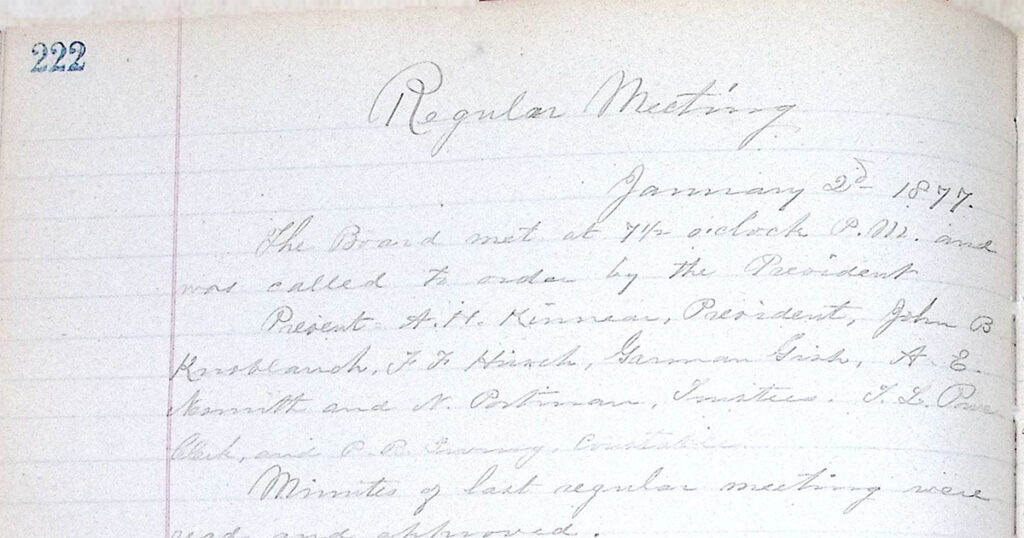
The documents had been sitting on a shelf. They included early township and village records, court records, tax documents, minutes, and ordinances, all dating back to 1841.
There was an obvious historical value to the collection, but there was also a practical problem: these documents weren’t particularly useful to the public if nobody could easily access them.
Nearly a year later, the president of the Metamora Association For History Preservation took on the task of scanning the documents using a specialized scanner.
That step was critical. Before anything could be put online, we needed a reliable digital copy of the originals.
This wasn’t something one person could just throw together. The project depended on different people contributing different pieces of the process.
Building A Safe Digital Foundation With Google Workspace
Once the documents were scanned, we uploaded them to Google Workspace. (I found that Google Workspace gives nonprofits a free account, a huge boost to our work!)
This gave us a cloud-based backup of the collection and separated the preservation of the documents from the website itself.
The underlying documents needed to remain safely stored regardless of what happened to the website. A thumb drive in someone’s basement is not a safe backup strategy.
From there, the challenge became one of organization and presentation: How do you take hundreds of individual historical documents and make them understandable and useful to someone visiting a website decades later?
Using WordPress To Organize The Collection
I used WordPress to create an individual post for each document.
Each post provides a short description of the document and links to the full scanned file stored in Google Drive. The Drive files are configured so visitors can view them without downloading them. If someone needs an original copy, they can contact the organization to request it.
I considered building a custom post type specifically for the archive. Ultimately, I decided to use standard WordPress posts because they provided a practical way to get the collection online without over-engineering the first phase of the project.
Each post is categorized by type to populate a tagged with the year. Eventually, as the documents are transcribed, we’ll tag the documents with local names, landmarks, and more, so people can more easily find related information on our site.
Connecting The Documents To The Bigger Story
The archive is organized into several categories, including:
- Township minutes
- Court records
- Tax documents
- Village minutes
- Village ordinances
Each category has its own landing page, which creates multiple ways for someone to explore the collection.
A visitor might be interested specifically in village ordinances. Another might want to see everything that happened in 1865. Someone researching a particular event could potentially move between different types of records from the same period.
The structure also follows a basic inbound marketing principle: individual pieces of content connect back to broader “pillar” pages, creating a topic cluster rather than leaving each document as an isolated page.
In this case, the same concept that helps organize a marketing website can also help organize history.
The Next Phase: Making The Documents Searchable
The current archive of scanned documents is only the beginning.
In a future phase, we’ll run the scanned documents through OCR (optical character recognition).
That will allow us to extract the text from the historical documents and incorporate it into the corresponding WordPress posts.
For example, instead of an online entry simply saying that a document contains the 1865 village minutes, the eventual page could contain the transcribed text of those minutes alongside access to the original scanned document.
That changes what the archive can be used for.
Instead of requiring someone to manually open hundreds of scanned pages, historical researchers and search engines will be able to interact with the text.
What Makes This Project Meaningful
The technology is interesting, but the real value is what the technology makes possible.
These documents contain the early records of the people who governed, worked, paid taxes, settled disputes, and made decisions that helped shape Metamora.
For generations, those records existed primarily as physical documents that wound up tucked away, collecting dust.
Now we’re beginning to build a bridge between those original records and the people who want to understand the community’s history today.
The village helped identify the collection and provided access to the records and the institutional home for the project. Our organization took on the work of digitizing the documents and creating the architecture for it through WordPress implementation, and process for presenting the collection online. We even identified gaps in our records and partnered with a state agency to retrieve missing ones.
Lessons From The Project
Technology Works Best When It Supports The Mission
It would have been easy to focus entirely on the technical side—custom post types, WordPress architecture, Google Drive integrations, OCR, and search.
But the technology exists to solve a much simpler problem: How do we make these records accessible without losing the connection to the originals?
That question helped guide the decisions about storage, presentation, and future development.
Digital Preservation Is More Than Scanning
Scanning a document creates a digital copy. It doesn’t automatically create an archive.
An effective digital archive also needs a system for storing, organizing, describing, finding, and maintaining those files.
This project brought all of those pieces together: specialized scanning, cloud storage via Google Workspace, WordPress, reusable page structures, categorization, tagging, and eventually OCR.
Collaboration Can Uncover Things That Would Otherwise Remain Hidden
Perhaps the most rewarding part of the project has been seeing what was hiding on that shelf. Documents that might have remained largely unknown are becoming accessible to the community.
For example, we’ve learned for the first time through village minutes that former Vice President Adlai E. Stevenson served a one-year term as a village trustee when he lived in Metamora, not long after former President Abraham Lincoln practiced law in Metamora.
Looking Ahead
The archive will continue to evolve as more documents are digitized, organized, and processed.
The long-term goal is to create a useful digital resource for people interested in Metamora’s history, from lifelong residents and local historians to researchers, students, and people trying to understand how the community developed.
What started as a shelf of old documents is becoming something much more valuable: a digital connection to the people and decisions that helped build Metamora.